
Transient-RAG: A Graph That Is Built for One Question and Then Forgotten
Most graph RAG systems build one huge knowledge graph in advance and reuse it for every question, an assumption that collapses as soon as someone asks a what if question. Transient RAG instead builds a small purpose made graph at answer time, tailored to that single query, exploring hypothetical links, and then dissolves it. The result is stronger multi hop accuracy and a huge jump on counterfactual questions, with no index to maintain at all.
Most graph RAG systems build one huge knowledge graph in advance and reuse it for every question, an assumption that collapses as soon as someone asks a what if question. Transient RAG instead builds a small purpose made graph at answer time, tailored to that single query, exploring hypothetical links, and then dissolves it. The result is stronger multi hop accuracy and a huge jump on counterfactual questions, with no index to maintain at all.
Why it matters
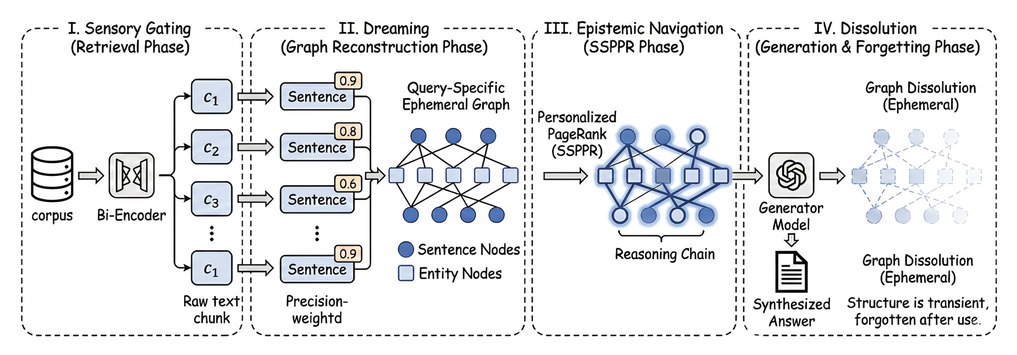
Retrieval augmented generation works well when the world holds still. It breaks when the question moves the world: ask what would happen if Los Angeles sat on the east coast, and a static graph keeps returning the real Los Angeles, faithfully grounded in facts that no longer apply. Transient RAG treats the graph not as a permanent library but as a scratchpad. For each query it retrieves a handful of passages, breaks them into sentences, scores each sentence for relevance, and lets the model assemble a small working graph of that specific question. Because nothing is precomputed, the graph is free to contain edges the knowledge base never stated.
The engineering payoff is striking. Static graph RAG pays a large storage bill for a global index and keeps paying a maintenance bill every time the corpus changes. Transient RAG pays neither: storage drops to zero and construction cost scales with the number of retrieved chunks rather than the corpus size. On the ifQA counterfactual benchmark it reaches 69.4 EM against 53.3 for HippoRAG2, a 30.2 percent relative gain in exact match and 28.3 percent in F1, while on HotpotQA it also edges ahead at 63.8 EM and 73.3 F1. The framework names its stages after cognition, sensory gating, dreaming, epistemic navigation and dissolution, because that is exactly what it is doing: reconstructing a memory that fits the question and then letting it go.
Key findings
- Counterfactual leap On the ifQA counterfactual benchmark, Transient RAG reaches 69.4 EM and 75.2 F1, a 30.2 percent relative EM gain and 28.3 percent F1 gain over HippoRAG2.
- HotpotQA result On 1,000 sampled HotpotQA questions it scores 63.8 EM and 73.3 F1, beating HippoRAG2 by 1.4 and 3.2 points respectively.
- 2WikiMultiHopQA On the 2WikiMultiHopQA multi hop benchmark it reaches 67.5 EM and 74.1 F1, competitive with the strongest static graph baseline while requiring no index.
- Zero index upkeep Storage cost falls to zero because the graph is built on the fly and dissolved after generation, instead of a persistent global index costing O of corpus size.
- Cheap construction Graph construction complexity is linear in the number of retrieved chunks (k = 20) rather than in the corpus size.
- Noise filtering wins Removing the Semantic Sentence Personalized PageRank gating drops HotpotQA EM by 9.6 points, showing sentence level filtering beats coarse chunk retrieval.
- Dreaming is decisive Removing hypothetical edge injection cuts ifQA EM from 69.4 to 42.8, a 26.6 point fall, confirming inferred links drive counterfactual reasoning.
- Baseline context A plain zero shot Qwen3 8B scores only 21.7 EM on ifQA, while naive RAG with top 20 passages reaches 34.4, far behind the 69.4 of Transient RAG.
Why it stands out
- Builds a question specific graph at inference time instead of maintaining a giant static index
- Adds hypothetical edges so the model can reason over scenarios the knowledge base never stated
- Sentence level relevance scoring removes the noisy sentences that poison chunk based retrieval
- 69.4 EM on ifQA counterfactual questions versus 53.3 for the strongest static graph baseline
- Storage cost drops to zero and graph construction scales with retrieved chunks, not corpus size
What it means for practitioners
If you run a retrieval system over documents that change often, or over users who ask hypothetical questions, Transient RAG is worth a close look. Nothing needs to be reindexed when the corpus moves, because there is no persistent graph to move. The paper also reports a clear design rule for builders: keep two separate mechanisms. Use sentence level filtering to throw away noise, and use a model driven phase that proposes inferred edges to connect a premise to its consequence. Ablations show the first matters most for ordinary multi hop QA and the second matters most for counterfactual QA, so teams that need only factual lookup can skip the dreaming phase, while teams handling policy, forecasting or diagnosis scenarios should not.
The authors frame the leftover work as memory consolidation: deciding which inferred links were valuable enough to keep and let into a long term store. That is the natural next step for anyone moving this from a benchmark into production, where the transient working memory of each query could slowly shape an evolving knowledge base instead of vanishing entirely.
Related reading
Get the paper & cite it
Official citation: Linquan Wu, Haoyu Yang, Shaochao Lin, Jacky W. Keung (2026). Transient-RAG: Ephemeral Graph Topology for Dynamic Reasoning. Int. Conf. Computer Supported Cooperative Work in Design (CSCWD). DOI: .