
Reading the Room: How Four Alignment Signals Expose a Scam Before the Money Request
Modern romance and investment scams no longer arrive as one deceptive message. They are built over hundreds of chat turns, where fake affection is tuned while the real intent drifts away. This COMPSAC 2026 paper measures that drift directly, tracking four levels of conversational alignment and showing that scammers keep surface wording aligned while meaning quietly falls apart. When those signals were shown to users, detection F1 rose from 0.61 to 0.82 in a 30 participant study.
Modern romance and investment scams no longer arrive as one deceptive message. They are built over hundreds of chat turns, where fake affection is tuned while the real intent drifts away. This COMPSAC 2026 paper measures that drift directly, tracking four levels of conversational alignment and showing that scammers keep surface wording aligned while meaning quietly falls apart. When those signals were shown to users, detection F1 rose from 0.61 to 0.82 in a 30 participant study.
Why it matters
Online scam detection today still leans on snapshots. A single message is scored against keyword lists or a classifier, and the user is hit with an interruptive warning. That model works poorly for the scams that cause the deepest harm, which are the slow ones. A romance or investment scam can run for hundreds of messages, and the deceptive turn is often not a dramatic request but a small change in what the two speakers mean by the words they exchange. Snapshot signals cannot see a shift that exists only across a conversation.
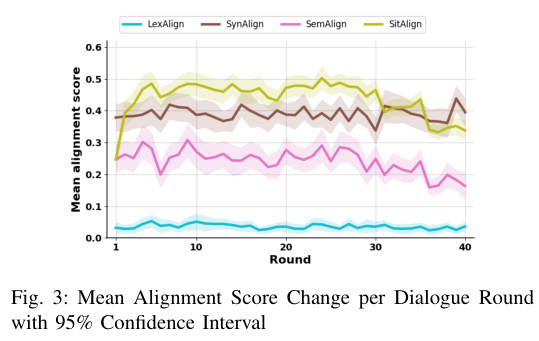
This work reframes scam detection as a reading of conversational dynamics. Building on the Interactive Alignment Model from psycholinguistics, the team measures how closely the two speakers converge on wording, grammar, sentence meaning, and the evolving picture of the situation each one carries. On real scam conversations the pattern is striking. As the money request approaches, low level lexical and syntactic alignment stay steady, since the scammer keeps echoing the victim to preserve rapport. High level semantic and situation model alignment both fall significantly, with p values below 0.001 over 47 conversations. That divergence is the fingerprint of strategic accommodation without genuine shared understanding, and surfacing it lets people reason about risk rather than simply receive a verdict.
Key findings
- Signals tracked The method computes four alignment signals per dialogue round, lexical, syntactic, semantic, and situation model, grouped into low and high levels.
- Real scam corpus The analysis drew on 83 real world scam conversations from the LoveFraud02 dataset, averaging 637.67 messages each, with 47 conversations meeting the 40 round preprocessing bar.
- What the data showed Semantic and situation model alignment declined significantly as the scam attempt approached, at p below 0.001, while lexical and syntactic alignment showed no significant change.
- Detection gain Multi level alignment hints lifted F1 from 0.61 with no hints to 0.82, precision from 0.56 to 0.81, and recall from 0.67 to 0.83.
- Beat the keyword baseline Keyword triggered alerts moved F1 only from 0.61 to 0.63, versus 0.82 for the full multi level hint.
- Faster confidence With alignment hints participants started forming confidence around round 8 and plateaued by round 13, compared with round 11 to round 17 for keyword alerts.
- User study Thirty native English speakers judged 20 balanced dialogues, 10 scam and 10 matched non scam, each 20 rounds long, across five hint conditions.
- Ablation result Low level only and high level only hints each helped, but neither matched the combined result, confirming that the levels were more informative together.
A tell that keyword lists miss
- Scammers keep copying the victim's wording and grammar to hold rapport, while meaning and shared situation drift apart.
- Showing that divergence as a non interruptive hint raised detection F1 from 0.61 to 0.82 and beat keyword alerts by a wide margin.
What it means for practitioners
For product and safety teams building scam detection, the practical takeaway is that signal quality beats signal volume. Keyword lists reacted to what a scammer says, while alignment reacted to how the conversation moves. Teams running chat platforms, dating apps, or banking assistants can compute these four scores incrementally as a dialogue unfolds, without waiting for a classifier to fire, and can present them as a quiet side panel rather than a blocking pop up.
For security awareness and design, the paper offers a way to scaffold judgement rather than replace it. Users saw recent alignment scores alongside a short textual pattern hint, and their confidence in spotting fraud formed earlier and settled higher, with significant overall differences across conditions at p below 0.001. That points toward interfaces where the system shows its reasoning about a conversation and lets the person decide, a model that scales naturally to LLM assisted coaching where a language model can narrate the alignment dynamics in plain language.
Related reading
Get the paper & cite it
Official citation: Zhenyu Mao, Jacky W. Keung, Xiangyu Li, Yicheng Sun, Kehui Chen, Jingyu Zhang, Jialong Li (2026). Making Sense of Scams: Understanding Scam Conversations Through Multi-Level Alignment.. COMPSAC. DOI: 10.1109/COMPSAC69091.2026.00163.