
When AI Tutors Go Cold: Making Large Language Models Emotionally Safe for Students
Students now turn to AI chatbots not just for answers but for reassurance when they feel confused or stuck. This COMPSAC 2026 paper found that 15.1 percent of real AI tutoring replies from a widely used model carried subtle emotional risk, such as dismissive or blaming tone, and shows a plug and play add on that cuts that rate to 4.5 percent without touching the model itself.
Students now turn to AI chatbots not just for answers but for reassurance when they feel confused or stuck. This COMPSAC 2026 paper found that 15.1 percent of real AI tutoring replies from a widely used model carried subtle emotional risk, such as dismissive or blaming tone, and shows a plug and play add on that cuts that rate to 4.5 percent without touching the model itself.
](/news/img/psych-safe-ai-tutors.JPG)
Why it matters
Large language models have quietly become study partners. Students ask them to explain a concept, check a solution, or simply calm them down when a problem refuses to click. That means every reply carries two messages at once: the facts, and how the reply makes the learner feel about themselves. The second message has been almost entirely unmanaged. This study puts a number on the problem for the first time at scale. Across 42,172 genuine AI responses collected over ten days at two universities, experts judged 6,384 of them, or 15.1 percent, to be emotionally risky. The typical offenders were not insults. They were lines like this is basic, you should already know it, or just redo the steps carefully, likely your mistake. Linguistically polite, pragmatically cold, and almost invisible to the toxicity filters that standard safety systems rely on.
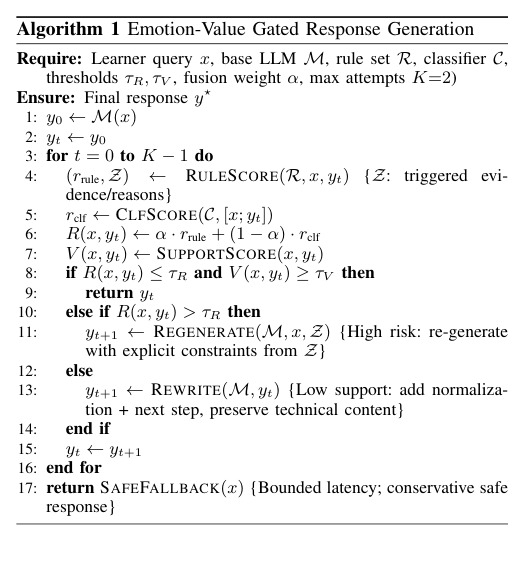
The second contribution is a way to fix it that universities can actually adopt. Most institutions rent AI as a black box service, with no access to weights, no budget for fine tuning, and no way to retrain a vendor model. The team designed an emotion value gate that sits after the model and before the student. A fast rule checker and a compact classifier read each draft reply together with the student question, score its harm risk and its support value, and either let it through, regenerate it with explicit constraints, or rewrite the tone while leaving the technical content untouched. Deployed for 12 days with 24 students, it dropped risky replies from 15.1 to 4.5 percent, a relative reduction above 70 percent, while expert rated pedagogical helpfulness rose from 3.91 to 4.46 out of 5. Emotional warmth and instructional rigor improved together, which is the headline finding for education technology.
Key findings
- Real interactions studied The team collected and expert labelled 42,172 genuine student and AI exchanges over a continuous 10 day period at two universities.
- Baseline emotional risk Experts flagged 6,384 replies, or 15.1 percent, as emotionally risky, with dismissive or cold tone the most common category at 6.0 percent.
- Risk after the gate With the emotion value gate in place, risky replies fell from 15.1 percent to 4.5 percent, a relative reduction of more than 70 percent.
- Dismissive tone collapse Dismissive and emotionally cold replies, the largest category, dropped from 6.0 percent to 1.8 percent of all responses.
- Blame collapse Learner directed blame messages fell from 4.3 percent to 1.2 percent of responses.
- Emotional safety score Expert rated emotional safety climbed from 3.42 to 4.24 on a 5 point scale across 27,000 gated responses.
- Supportive value score Supportive value, the measure of encouragement plus concrete next steps, rose from 3.67 to 4.39 out of 5.
- Pedagogical helpfulness Pedagogical helpfulness improved from 3.91 to 4.46, showing emotional care did not dilute instructional quality.
- Overall quality Overall response quality rose from 3.38 to 4.05 on the same 5 point scale.
- Student study Twenty four students used the enhanced assistant naturally for 12 days and all completed the post study survey.
- Students felt supported Students rated the statement that the AI responses felt emotionally supportive at 4.63 out of 5.
- Willingness to keep using Willingness to continue using the AI for learning scored 4.41 out of 5, and tone improvement over prior tools scored 4.59.
- Comfort asking questions Comfort with asking the AI questions scored 4.24 out of 5, with logs showing students previously reluctant to ask basic questions now did so freely.
- Correctness stays put Students rated the change in answer correctness a neutral 3.28, the intended outcome, since the gain is emotional rather than technical.
- Zero model modification The framework changes no weights, no architecture, and no training, so it works with any off the shelf or proprietary LLM.
- Not just longer flattery Gated responses run 18.42 percent longer, and experts confirmed the extra text is scaffolding and next steps, not empty praise.
- Escalation to humans The enhanced AI more often pointed students to instructors or counselors when self guided help was not enough, framed as a normal responsible step.
A safety layer that leaves the model untouched
- Rule checker plus a compact RoBERTa classifier score every draft reply for harm risk and support value
- High risk triggers regeneration with explicit constraints, low support triggers a cheap tonal rewrite
- Two attempts maximum, then a safe fallback keeps latency bounded and guarantees no risky reply ships
- Set thresholds as policy, so campuses can tighten rules for younger or more vulnerable learners
What it means for practitioners
If your institution buys AI through an API and cannot retrain it, you can still govern how it treats students. Treat emotional quality as an operational layer rather than a modelling problem. Score each outgoing reply for harm risk and support value, and gate on both: a hard ceiling on dismissive, blaming, or belittling language, and a floor on constructive support such as normalizing difficulty, giving concrete steps, and offering a clear next action. Keep the support floor honest by explicitly forbidding generic praise, or you will trade coldness for empty flattery, which students see through just as fast.
Two implementation details carry most of the value. First, evaluate the reply conditioned on the student question, since the same sentence lands very differently when a learner has just said I am stuck. Second, keep the intervention cheap and bounded. A rewrite that preserves technical content costs far less than a full regeneration, so reserve regeneration for genuine harm and use rewriting for weak support. Log the reasons for every intervention. That audit trail lets teaching staff tune thresholds to local norms and gives a defensible answer when administrators ask why a reply was altered.
Related reading
Get the paper & cite it
Official citation: Yicheng Sun, Jacky W. Keung, Hi Kuen Yu, Yihan Liao, Zhenyu Mao, Yishu Li, Xiaoxue Ma (2026). Designing Psychologically Safe AI Tutors for Students: An Emotion-Aware Post-Hoc Intervention for LLM-Assisted Learning.. COMPSAC. DOI: 10.1109/COMPSAC69091.2026.00199.