
When parsing goes wrong: How tiny log parsing mistakes quietly break AI anomaly detection
Modern software systems generate millions of log messages, and AI systems are used to spot the rare ones that signal a real problem. But before any AI can analyze logs, the raw text must be cleaned up by a step called log parsing, and this study finds that small parsing mistakes systematically weaken downstream anomaly detection. Across 20 datasets, the researchers show that fixing these parsing errors reliably improves detection accuracy, especially on hard, messy industrial logs.
Modern software systems generate millions of log messages, and AI systems are used to spot the rare ones that signal a real problem. But before any AI can analyze logs, the raw text must be cleaned up by a step called log parsing, and this study finds that small parsing mistakes systematically weaken downstream anomaly detection. Across 20 datasets, the researchers show that fixing these parsing errors reliably improves detection accuracy, especially on hard, messy industrial logs.
Why it matters
Every AI system that watches over software first needs the raw log text to be turned into a clean, structured form. This cleaning step is called log parsing, and it is usually treated as a boring preprocessing detail. This study shows it is not boring at all: when a parser merges two different events into one, or splits one event into many, or mangles a key identifier, it quietly changes what the downstream AI sees. The result is that genuinely anomalous logs get missed, and normal logs get flagged as problems. The paper is the first to name six recurring parsing error types and to prove, with statistics, that correcting them lifts detection accuracy across every dataset and model tested.
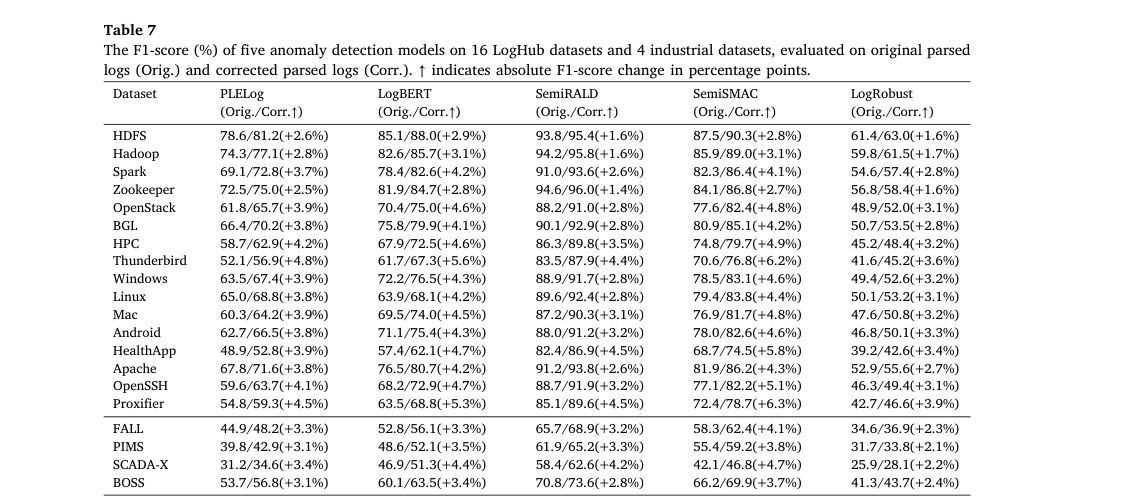
The researchers went far beyond public benchmarks. They built four real industrial log datasets from live production systems in manufacturing, process control, energy infrastructure, and enterprise services, then interviewed 11 engineers who maintain those systems. The headline finding: fixing parsing errors raised anomaly detection F1 scores by an average of 3.61 points, a gain that was statistically reliable in all 100 dataset and model combinations. On industrial logs, the relative improvement was even larger, reaching about 7%. This is not a marginal theory result, it is evidence that practitioners can reclaim real detection performance simply by taking parsing fidelity seriously.
Key findings
- Datasets evaluated The study spans 16 public LogHub datasets plus 4 proprietary industrial log datasets, 20 datasets in total.
- Parsers tested Six parsers were analyzed: three rule based (Drain, Spell, AEL) and three LLM based (DivLog, LILAC, LUNAR).
- Detection models Five anomaly detection models were evaluated: PLELog, LogBERT, SemiRALD, SemiSMAC, and LogRobust.
- Average F1 gain from fixing parsing Correcting parsing errors improved anomaly detection F1 scores by an average of 3.61 percentage points across 100 dataset and model pairs.
- Statistical reliability All 100 dataset and model pairs showed a positive improvement, reaching a statistically reliable result (p < 0.001) with a perfect rank biserial effect of r = 1.00.
- Industrial gain On the four industrial datasets, fixing parsing errors gave a relative improvement of about 7%, larger than the roughly 5.5% on public LogHub datasets.
- Industrial template diversity Industrial logs carry far richer template spaces, with up to 6039 event templates in the SCADA X dataset versus as few as 11 in some public benchmarks like Proxifier.
- Cross dataset augmentation Adding 7000 curated public logs to scarce industrial training data improved detection F1 by an average of 7.30 points, with gains in 17 of 20 dataset and model combinations.
- Negative transfer risk Augmentation was model dependent, and could hurt performance: LogBERT dropped about 2% on two industrial datasets when external logs were semantically mismatched.
- Six parsing error types The experts distilled six recurring parsing error types, five of which appear in both rule based and LLM parsers, plus one unique to LLM semantic rewriting.
- Most common errors Template over splitting (24.7%) and template over merging (21.4%) are the two most prevalent parsing errors, together accounting for nearly half of all observed errors.
- LLM hallucinated templates LLM based parsers introduced a distinctive failure mode, semantic rewriting, which accounted for about 16% of their errors by paraphrasing logs in ways not present in the original text.
- Engineer consensus 10 of 11 interviewed engineers agreed that industrial logs are far more heterogeneous, context dependent, and rapidly evolving than public benchmark logs.
- Best performing model SemiRALD achieved the highest anomaly detection F1 scores across nearly all datasets, and was also the most robust to parsing noise.
Small parsing mistakes, big detection losses
- Fixing parsing errors lifted anomaly detection F1 by 3.61 points on average across 100 dataset and model combinations
- Gains were statistically reliable in all 100 pairs, with a relative improvement of about 7% on messy industrial logs
- Two error types, template over splitting and over merging, account for nearly half of all parsing errors
- Cross dataset augmentation lifted detection by 7.30 F1 points, but only when the borrowed data was compatible
What it means for practitioners
For engineers who build or run log based monitoring, the practical message is clear: log parsing is not a throwaway preprocessing step, it is a first order driver of detection quality. Six concrete error types are worth auditing for, led by template over splitting, where minor lexical variation fragments one event into dozens of templates, and template over merging, where distinct success and failure events collapse into a single template. Both quietly blur the boundary between normal and anomalous behavior, inflating false alarms while suppressing real signals.
The augmentation finding is equally actionable. When industrial training data is scarce, borrowing curated logs from public datasets can be genuinely helpful, raising detection by an average of 7.30 F1 points. But more data is not automatically better. The gains are model dependent and they can reverse into negative transfer when the borrowed logs are semantically mismatched, with LogBERT dropping about 2% on two industrial datasets. Practitioners should treat cross dataset training as a compatibility sensitive decision, favoring diversity aware and domain compatible sampling over indiscriminate scaling.
The interviews add a more human caution. Engineers consistently valued robustness, faithfulness, and traceability over marginal benchmark gains, and several were wary of LLM based parsers whose fluent rewrites can omit the exact error codes, thresholds, and identifiers needed for debugging and auditing. Even a 16% semantic rewriting error rate in LLM parsing is a real concern when every alert must be traced back to an original log line. For production, the winning configuration appears to be a robust semi supervised detector, like SemiRALD, paired with parsing outputs that stay faithful to the raw log.
Related reading
Get the paper & cite it
Official citation: Yicheng Sun, Jacky Wai Keung, Yishu Li, Xiaoxue Ma, Hi Kuen Yu (2027). When parsing goes wrong: Revisiting log anomaly detection from parsing to deployment.. Journal of Systems and Software. DOI: 10.1016/j.jss.2026.113161.