
LogMeta: few-shot meta-learning for log anomaly detection that adapts to new systems
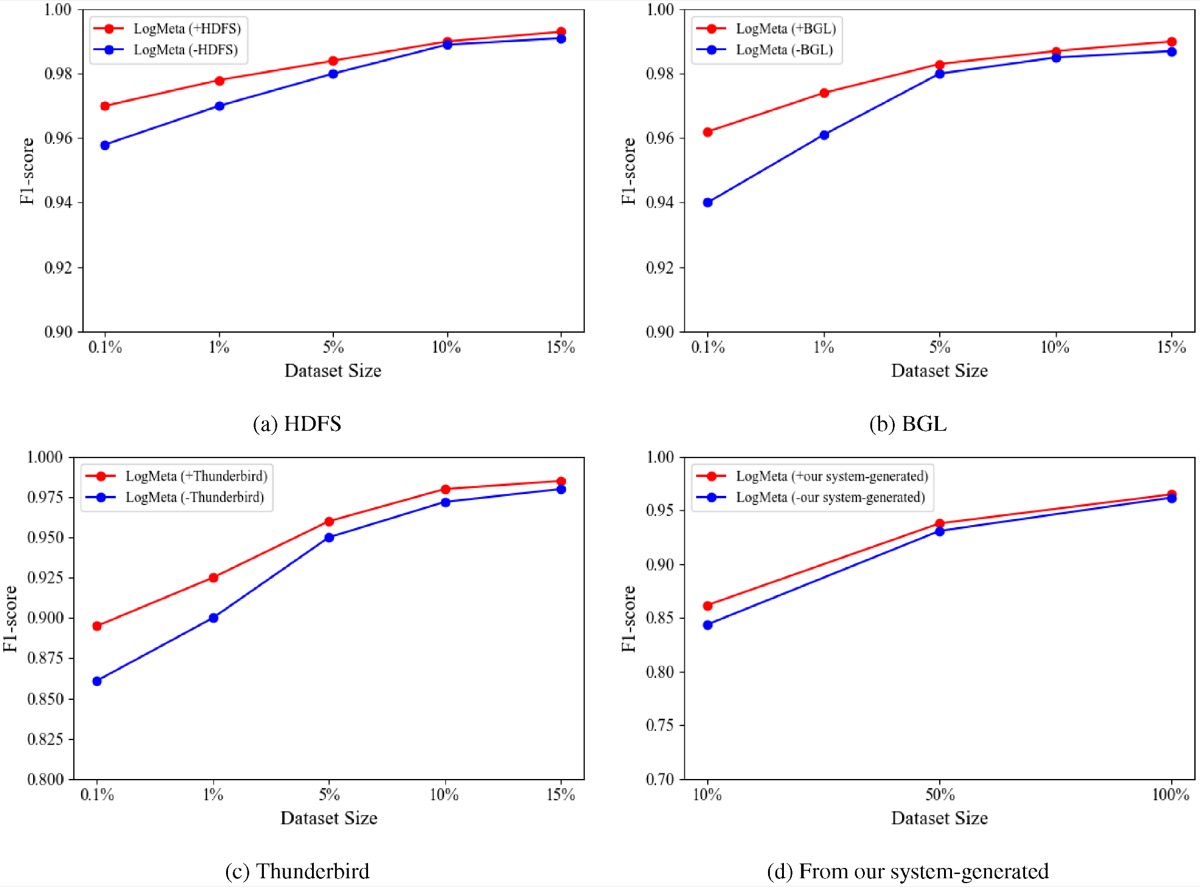
A semi-supervised framework fusing model-agnostic meta-learning with a hybrid language model reaches up to 28.3% higher F1 under low-resource scenarios.
Deep log-anomaly detectors struggle with heterogeneous log formats and scarce labeled anomalies. LogMeta combines Model-Agnostic Meta-Learning (MAML) with a hybrid language model — RoBERTa for semantics plus Bi-LSTM and attention for sequence dependencies — so it adapts to unseen systems from a few samples.
Why it matters
Log anomaly detection is critical for system reliability, but deep models struggle with heterogeneous log formats and scarce labeled anomalies; we propose LogMeta, a semi-supervised framework combining MAML with a hybrid language model to address these challenges.
Key findings
- Large accuracy gains Consistently outperforms state-of-the-art supervised and unsupervised methods, achieving up to a 28.3% improvement in F1-score under low-resource scenarios.
- Few-shot adaptation MAML enables rapid adaptation to unseen log systems with only a handful of samples, reducing reliance on large labeled datasets.
- Domain transfer Maintains robust performance across diverse log datasets with minimal fine-tuning — strong generalization to new environments.
- Deployable efficiency Achieves competitive training and inference times, suitable for real-time anomaly detection in large-scale systems.
LogMeta
- Integrates Model-Agnostic Meta-Learning (MAML) with a hybrid language model for adaptive, efficient log anomaly detection.
- Hybrid model combines RoBERTa (semantic representations) with Bi-LSTM and attention mechanisms to capture sequential dependencies and critical features.
- Semi-supervised design balances training cost with robustness under label scarcity and heterogeneous log formats.
- Evaluated on multiple benchmark datasets against supervised and unsupervised baselines under low-resource settings.
What it means for practitioners
If you monitor logs across heterogeneous systems with few labels, LogMeta's meta-learning approach lets you adapt a detector to a new system from a handful of samples — no large labeled corpus needed — while staying fast enough for real-time use.
Get the paper & cite it
Official citation: Yicheng Sun, Jacky W. Keung, Hi Kuen Yu, Wenqiang Luo (2026). LogMeta: A few-shot model-agnostic meta-learning framework for robust and adaptive log anomaly detection. Journal of Systems and Software. DOI: 10.1016/j.jss.2026.112781.