
Bridging the responsibility gap: deriving human-oversight requirements for GenAI-enabled software
A three-layered requirements-engineering methodology lets analysts trace system patterns and human roles to concrete oversight requirements that keep accountability anchored to people.
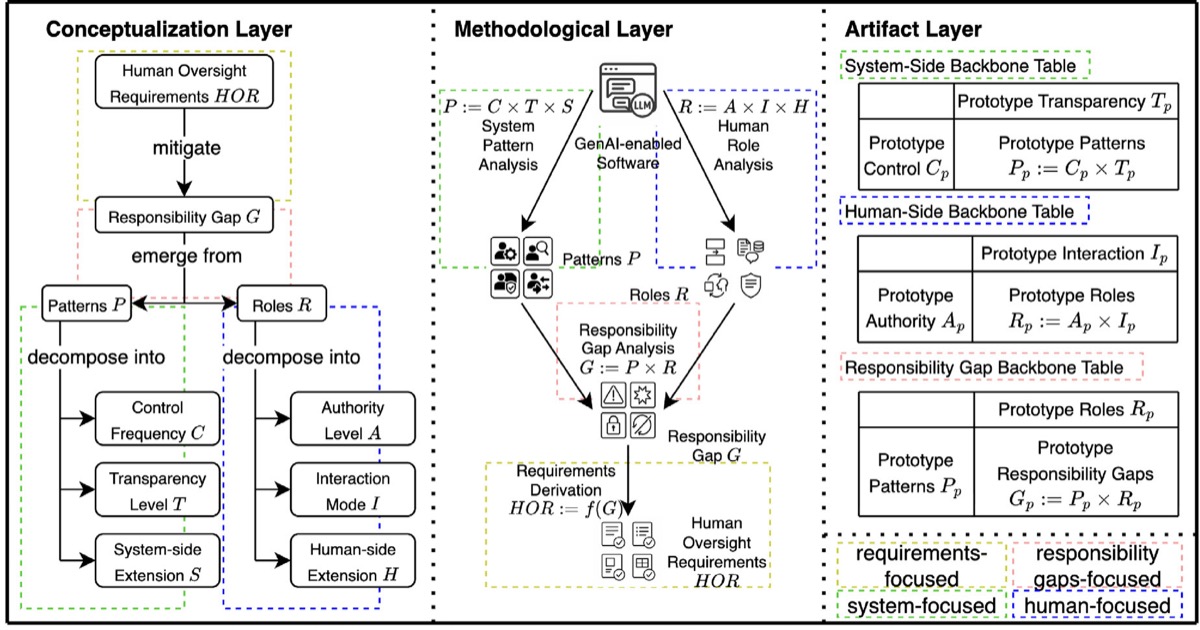
As generative AI becomes an active component of reasoning and decision support, accountability becomes diffuse: developers can't see how models reach conclusions, users can't fully control behavior, organizations struggle to trace decisions. The authors argue human oversight should be formalized as an explicit category in requirements engineering, and propose a design methodology that identifies responsibility gaps by aligning system-side patterns (control, transparency) with human-side roles (authority, interaction), then derives oversight requirements and documents the reasoning in a reusable Deductive Backbone Table.
Why it matters
Responsibility gaps have become increasingly pronounced in GenAI-enabled software; existing requirements engineering approaches remain limited in analyzing them from a human-oversight-requirements perspective.
Key findings
- Three research gaps in RE Measured against ISO/IEC/IEEE 29148 quality attributes, existing RE processes for GenAI-enabled software show deficiencies at three levels: conceptual, methodological, and artifact.
- A backbone-anchored deductive pipeline Anchored on the intersections C × T (control × transparency) and A × I (authority × interaction), the pipeline guides analysts from system-pattern and human-role analysis to gap identification and oversight-requirement derivation.
- Favorable participant perceptions In a controlled within-subject study of 24 participants, the enhanced GORE approach outscored the baseline on all six dimensions plus overall effectiveness (mean 4.33, SD 0.70), all significantly above neutral (Wilcoxon, p < .001).
- Strongest gains in consistency and traceability Expert raters scored the enhanced artifacts higher on six of seven quality items, with the largest gains for consistency (+0.79) and representational traceability (+0.79).
- Caveat on generalizability The student-dominated sample (17 of 24 CS students) and lack of real industrial validation mean these are initial evidence of analytical usefulness, not industrial effectiveness.
Backbone-anchored deductive pipeline
- Step 1 — System Pattern Analysis: abstract the GenAI system as a pattern P := C × T × S (control frequency, transparency level, extensions).
- Step 2 — Human Role Analysis: model oversight roles as configurations R := A × I × H (authority level, interaction mode, extensions).
- Step 3 — Responsibility Gap Analysis: align each system pattern with each human role (G := P × R) to expose mismatches in controllability, transparency, or authority.
- Step 4 — Requirements Derivation: transform each gap into framework-specific constructs (HOR := f(G)) yielding system-side or human-side oversight requirements tagged for traceability.
What it means for practitioners
To keep accountability anchored to humans in GenAI-enabled systems, explicitly characterize the system's control frequency and transparency, map every oversight role's authority and interaction mode, surface responsibility gaps from the resulting system-pattern × human-role pairings, and record the reasoning chain in a Deductive Backbone Table so it survives into documentation and review.
Get the paper & cite it
Official citation: Zhenyu Mao, Jacky W. Keung, Yicheng Sun, Yifei Wang, Shuo Liu, Jialong Li (2026). Towards requirements engineering for GenAI-enabled software: Bridging responsibility gaps through human oversight requirements. Information and Software Technology. DOI: 10.1016/j.infsof.2026.108319.