
Building Bridges to Student Growth: LLM Feedback That Scales Beyond Grades
Teachers know that the most powerful words a student hears are specific, personal, and encouraging. Yet in large schools, writing an individual narrative comment for every activity, every award, and every student is simply not possible at scale. This CityU research introduces an LLM powered system that turns structured extracurricular records into short, professional feedback drafts, tested on 100 Hong Kong secondary students with 1,067 activity entries and five open source models. The best systems scored 4.48 out of 5 on overall quality, showing that generative AI in education can help teachers deliver holistic feedback at a pace they never could alone.
Teachers know that the most powerful words a student hears are specific, personal, and encouraging. Yet in large schools, writing an individual narrative comment for every activity, every award, and every student is simply not possible at scale. This CityU research introduces an LLM powered system that turns structured extracurricular records into short, professional feedback drafts, tested on 100 Hong Kong secondary students with 1,067 activity entries and five open source models. The best systems scored 4.48 out of 5 on overall quality, showing that generative AI in education can help teachers deliver holistic feedback at a pace they never could alone.
Why it matters
Feedback is one of the most powerful levers in education, but it is also one of the most expensive. Research going back to Hattie and Timperley shows that timely, specific, actionable comments drive learning far more than grades alone. The problem is economizing human attention. When a teacher faces thirty or forty students, each with a dozen or more activities across the year, individualized narrative comments collapse into generic phrases like good effort or keep it up. This is precisely where holistic education suffers most: the non academic side of a student, their leadership, service, competitions, and growth, is rich in evidence but starved of articulation. This work asks whether large language models can bridge that gap without sacrificing accuracy or trust. The answer from the field study is yes, provided the AI is positioned as a drafting aid and not a replacement for human judgement.
What makes this contribution distinctive is that it tackles the harder, less studied half of the feedback problem: extracurricular achievement. Most AI feedback work concentrates on grades, essays, or exam performance, because those inputs are numeric and easy to score. But schools increasingly recognize that character, community service, and competition results matter just as much for holistic student development, and those are exactly the records that resist automatic writing. By normalizing activity logs into structured JSON and conditioning generation on them with carefully designed prompts, the team built a reproducible pipeline that any resource constrained school can run locally. The 500 evaluated outputs across five open source models give educators something practical they rarely get: a ranked, evidence based guide to which model size actually delivers the best balance of accuracy, stability, and cost.
Key findings
- Scale of the study The evaluation covered 1,067 extracurricular activity entries from 100 secondary school students across Forms 1 to 6.
- Models compared Five open source large language models were tested under identical prompts and hardware: DeepSeek R1, Gemma3, GPT OSS, Llama 3.1, and Qwen3.
- Outputs rated Three professional raters assessed 500 generated feedback outputs across five quality dimensions.
- Top overall score GPT OSS achieved the highest overall mean of 4.48 out of 5, with Gemma3 close behind at 4.45.
- Writing quality Fluency scores exceeded 4.6 across every single model, meaning AI drafts read smoothly and naturally.
- Coherence strength Coherence and clarity stayed uniformly high, ranging from 4.54 to 4.69 across all five models.
- Best faithfulness Faithfulness to the underlying records peaked at 4.68 for GPT OSS and 4.50 for Gemma3.
- Hardest dimension Coverage of all salient information was the weakest dimension, with scores spanning 3.48 to 4.25.
- The sweet spot Medium sized models between 20B and 27B parameters delivered the best tradeoff between accuracy and inference stability.
- Practical scope All models ran locally on a single workstation with an NVIDIA RTX 5090 GPU, requiring no cloud services or external data sharing.
Why this matters for holistic education
- Turns 1,067 raw activity records into personalised, encouraging narratives in minutes rather than weeks
- Gives schools a ready ranked guide to which open source model to deploy for feedback generation
- Keeps student data entirely on premises, with three human raters validating every dimension
What it means for practitioners
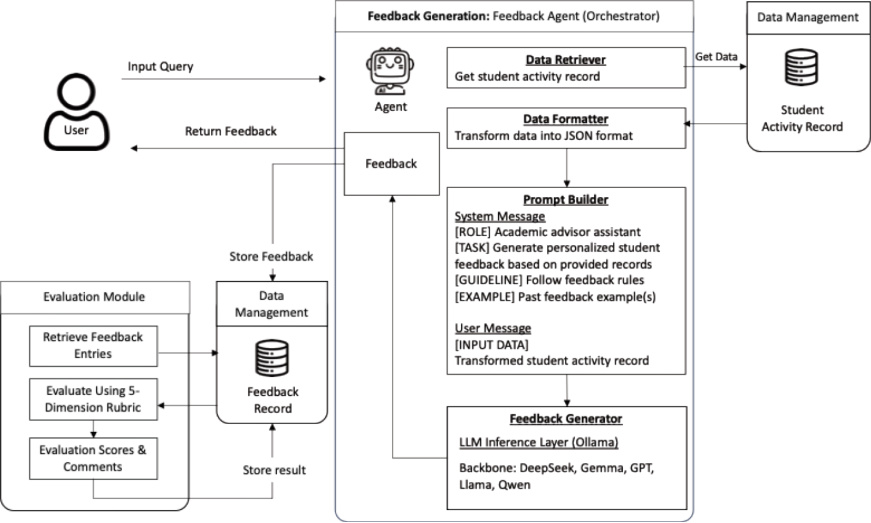
If you run a school, an academic advising office, or an edtech platform, this paper offers a practical blueprint you can adopt this term. The system's architecture is deliberately simple and portable. A data retriever pulls a student's activity and award records, a formatter converts them into clean JSON, a prompt builder layers role instructions, writing guidelines, and three authentic teacher written examples, and a feedback generator runs the prompt through a local model via Ollama. Every piece runs on a single workstation with consumer or prosumer graphics hardware, so student data never leaves the building. The team's evaluation design is equally reusable: five dimensions adapted from natural language generation research, a five point scale, masked model identities to remove brand bias, and a thirty minute calibration session before scoring begins.
The most actionable finding for practitioners is about model selection. Bigger is not better and smaller is not cheaper in a straightforward way. The 20B to 27B models, GPT OSS and Gemma3, consistently outperformed both the 8B Llama variant and the 32B reasoning models, because they combined enough reasoning capacity with stable, predictable inference. Schools planning a deployment should start there. The paper also translates its error analysis into concrete safeguards that require no retrieval infrastructure: force each draft to cite at least three concrete items from the record, maintain a glossary for award names so translations stay consistent, restrict prompts to extracurricular scope, and have reviewers concentrate their attention on coverage and faithfulness rather than style. Since fluency and coherence are already near perfect, teacher review time can be aimed exactly where it adds the most value.
Related reading
Get the paper & cite it
Official citation: Hi-Kuen Yu, Jacky W. Keung, Yicheng Sun (2026). Building Bridges to Student Growth: An LLM-Powered Feedback Generation System for Holistic Development. Technology in Education (Springer LNCS). DOI: .